Saturday, April 07, 2007

A Tour of Old Dhaka

On our last Friday in Bangladesh, we decided we needed to go see Old Dhaka – the tiny warren of streets that eventually gave birth to this sprawling city of 15 million. Hossain and Mithu, two of the drivers who work for the World Bank, said that they would be happy to serve as our drivers, tour guides and personal security detail. That sounded a lot more fun than haggling with some commercial tour operator, so we took them up on their offer.

Since we went down on a Friday morning, traffic was light and many businesses were closed. Still, there was plenty to see and do (and smell). We ran across these guys butchering sea turtles on the street in the Hindu district.


Old Dhaka also features a few nice older buildings. Some, like Ahsan Manzil (also called “the Pink Palace”), which was built as the personal home of Dhaka’s wealthiest landowner in the late 1800s, are no longer used, but others from the period are still serving as office buildings, shops, or even apartment houses.


One of the most interesting places in this part of Dhaka is the Armenian Church. The church was built in 1781 as the expansion of a chapel from the late 17th century. The Armenians had come as traders to this part of the world for centuries. Finally a Moghul emperor in the 1600s invited them to build their own settlements in Bengal ... and thus they built a church. The caretaker of the church, Mr. Martin, showed us around. He was very friendly, very knowledgeable, and very lonely. There are only 10 families in the church now, and it’s clear the community is slowly dying.

We headed down to the waterfront to see the produce being brought in to feed the metropolis of Dhaka. (Watermelon is in season now.) Patrick was tempted to get a shave and a haircut, but eventually decided against it.


One of our last stops was to visit Mithu’s family and see his new baby daughter, who is only 18 days old. He is an extremely proud father.


Mithu and Hossain gave us a wonderful tour of Old Dhaka. It seems both strange and fitting that we waited almost two years to do this tour, right before our departure. Now that we’re leaving Bangladesh, we have become more open to seeing it with a positive attitude. It was a good way to spend our last Friday here.

Friday, March 23, 2007

Packing Up in Dhaka

We're in our last days here in Dhaka.

As you can imagine, this is a pretty stressful time, even when so much of our move is being taken care of. After three days of packing, our house is now empty, save for the Embassy furniture and four suitcases’ worth of personal belongings. Our calendar is filling up with evening appointments as all of our friends ask to see us one last time before we go. Rabin (our guard) and Shanti (our housekeeper) are sad to see us go and worried about finding new jobs, so we're helping with that as much as we can. During all of this, we still have work to do -- Jennifer has some big meetings and conference calls with Washington over the next couple of weeks, while Patrick will be in Nepal all next week for work. On 11 April we'll board Thai Airways flight 322 to Bangkok.

And then there's Bhago.

Bangkok is not a good place for dogs. It's a big, crowded, modern city. The public parks don't allow dogs. We'll live in a small apartment on the 18th floor of a high-rise, with no garden space or yard. So we've decided it's best for Bhago not to join us there. We have a couple of options for him -- including sending him back to the States to live on Patrick's aunt's farm in Georgia -- but we think finding a home for him here in Bangladesh would be easiest for everyone, especially him.

Still, it's hard. We're really going to miss our little monster, and we know that no one will love him quite the way we have. He'll be fine in a good home, we know – and being a dog, he won’t miss us the way we’ll miss him. It's just tough to say goodbye.

For his part, Bhago has been awfully subdued over the last few days. People project all sorts of emotions onto their pets, so we don't want to go far as to say that he knows what's going on, but I'm sure he's picking up on the various emotional states in the house. There have been movers here, packing up boxes, yelling back and forth, and basically causing a lot of commotion. Normally this would have Bhago jumping up and down, barking, sniffing ... you know, all of that fun doggie stuff. Instead, he's mostly just watched them go by, sometimes with a heavy sigh. Jennifer jokingly said to Rabin (who spends a lot of time with Bhago during the day), "Maybe Bhago knows we're moving." Rabin replied, "I am thinking, Bhago know everything ... he just not say.”

And yet, he’s still his irrepressible self sometimes:


Saturday, March 10, 2007

Bonus Pictures from Nepal!

A few more pictures from our recent Nepal trip:

A (sadly) typical street scene in Kathmandu: traffic jam plus garbage heap. While we were there, one of the major landfills for Kathmandu was being blockaded by the people who live near it, so no garbage had been collected for about a week. Here the garbage has blocked half the street, greatly exacerbating the traffic problem (to say nothing of the smell).


This conveyance is very popular in Nepal. We've even seen them on the streets of Kathmandu. We'd bet that if you could make a kit for one of these -- call it the Himalayan Chopper Pickup -- you could make a mint selling them to rednecks in the States.


While we were walking through people's front yards, we came across this family making a phone call. They lived in what seemed like the middle of nowhere, so we were really surprised to see a battery-powered, cordless handset here! We couldn't really find out how they got the phone, how much it cost to make a call, or how exactly the whole thing worked -- after all, we were intruding on their personal family business -- but it was neat to see.


This woman is using a traditional Nepali method of carrying heavy loads. She has everything she wants carry in the basked at her back. A strap is running from the basket to her forehead; she uses her body weight -- and strong neck muscles! -- to keep the load balanced. Sherpas carrying loads up Mount Everest sometimes use the same technique, perfected over centuries.


This was a Red Cross clinic in a village in Pokhara. We spent a while visiting with these two guys, who volunteer at the clinic, doing health screening and giving advice. They were very proud of their work and happy to talk about it, even if you can't tell from the picture (though, to be fair, no one smiles for cameras as much as Americans do).


Believe it or not, this is our hotel room in Pokhara town. It was set up like a traditional Nepali cottage, complete with fireplace. Patrick used his firemaking skills (thanks, Dad) to warm up the place a bit before bedtime -- the bed was in a loft just above the sofa.


During our time in Nepal, a very important Hindu festival, Shivaratri, was celebrated. One of the most significant Shiva temples in the world is in Kathmandu, so thousands upon thousands of people gathered there to celebrate. They even celebrated in Pokhara ... right down to the dogs. If you look carefully, you can see a red mark between this puppy's eyes. It's what remains of his tika, a ritual mark used to anoit the Hindu faithful on holy days.

Friday, February 23, 2007

Kathmandu and Beyond

As part of his new job, Patrick has switched portfolios with his boss in Dhaka. Patrick’s boss will now handle the Bangladesh portfolio while Patrick will be responsible for Nepal. On 11 February (after a two-and-a-half hour flight delay) Patrick went to Kathmandu for a week to take over and introduce himself to his new colleagues. They’d all seen him before (in June 2006), but this was his first visit as the Contracting Officer responsible for their work. It was a busy but very successful week and a good start to his new job.

Jennifer came up in the middle of the week to join Patrick for a short vacation. She had planned to visit Kathmandu during the days while Patrick was in the office. As it turned out, the weather didn’t cooperate. It was cold & rainy almost all week – except for the one day when the Kathmandu Valley experienced its first snow in 63 years!

Fortunately the weather changed for the better once we started our vacation in earnest. On Friday we flew from Kathmandu to Pokhara, a town in the center of Nepal, just south of the Annapurna Range of the Himalaya. Our flight was delayed by almost three hours by fog, but the weather was warmer and sunny when we hit the ground in Pokhara. We were met at the airport by a forest green Land Rover Defender, which drove us up to Tiger Mountain Lodge.


Tiger Mountain Lodge was built ten years ago and was the brainchild of a British Army officer and mountaineer who had settled in Nepal. It sits about 40 minutes’ drive and a few thousand feet above the town of Pokhara, with a magnificent view of the Annapurna, including the holy mountain of Machhapuchhre (“Fish-Tail”). We had our own cabin with a lovely view of the valley.

A big thunderstorm rolled through on our first afternoon, so we stayed in our cabin, reading Michael Palin’s Himalaya on a bed with a bedspread made from the same cloth as Buddhist monks’ robes. One of the lodge staff brought us tea and biscuits around 5:00pm (in the middle of the pouring rain!). In the evenings, the lodge has a cocktail hour around a large open fire in the main building, followed by a three-course dinner in the dining room.


Although it sounds – and felt! – very luxurious, the lodge was surprisingly simple. It’s run on an ethos of sustainable tourism and is dedicated to minimizing negative impacts on the local environment and maximizing the benefits to the local community. For example, all of the soap is handmade, herbal soap from Nepal; hot water is available for only two hours in the morning and two hours in the afternoon (and is supplied by solar power); small kerosene heaters are used for the cabins and are run for only a few hours in the early evening (thus the thick bedspreads!); and almost all of the food served is grown by local producers in the surrounding villages. The staff was all local, with the exception of the General Manager, Marcus, a Brit who’s lived in Nepal for more than 20 years.

On our first full day we went on a seven-hour hike with Ollie and Georgie, two Brits who work in Kathmandu, and our local guide, Hari. Hari has worked at the lodge since it opened and is a master birdwatcher. We lost track of the many different kinds of birds we saw – kingfishers, kites, kestrels, sunbirds, egrets, and many more. We also saw water buffalo (raised for meat, since the Hindus in Nepal don’t eat beef) and even a few macaques prowling the rice paddies for discarded grains.


As part of the hike we went through a Gurung village. The Gurung, one of the ethnic groups of Nepal, form the overwhelming majority of those Nepali men who fight as mercenaries in the British Army in the legendary Gurkha regiments. The selection of the Gurkhas is a brutal test of physical fitness and discipline – there are slots for only 10% of those who apply every year. A Gurkha soldier makes the same take-home salary as a regular British Army soldier, which makes him a rich man back home in Nepal.

The village we visited was almost certainly the beneficiary of one of these soldiers. Everyone we met was extremely welcoming and friendly – pretty surprising, when you think about how often they must get overdressed Western hikers tromping through their front yards!

We sampled some raxsi, their local moonshine. It was remarkably good! (What is it about mountain people and moonshine?) Sadly for us, Hari was the only one who knew to bring an empty bottle, so he took home a fifth for about fifty cents.


The hike wasn’t very strenuous, but we did notice that we hadn’t worn our hiking gear in a couple of years. Of course, we were put to shame by the 70-year-old women striding past us in their plastic flip-flops, and the little kids scampering about in bare feet, just like the proverbial mountain goats. The last half-hour of the hike saw us climb Tiger Mountain on a near-vertical trail, gaining about 1000 feet in 30 minutes. We were all ready for a shower and a soft bed after that!

Two of the other guests at the lodge were a pair of real characters from England, Jenny and Carol. They were both in their sixties, travelling without their husbands for the first time ever, and having a grand time. We had a lot of fun chatting with them over dinner and hearing about their plans to go south to Chitwan National Park, one of our future vacation destinations, to ride elephants and look for rhinos and tigers.


Every morning we woke up to a spectacular view of the Annapurna. Machhapuchhre is the pyramidal mountain (it has a second peak, not visible here, which gives it the name “Fish-Tail”). As it is considered holy, it may not be climbed, and no one is reliably known to have reached its summit. As we watched the morning sun bathe it every morning, it seemed right that it hadn’t been “conquered.” It seemed a privilege just eat breakfast in front of such a beautiful panorama.


On our last day at Tiger Mountain we went for a shorter hike with Hari, passing mostly through villages and the omnipresent, terraced rice paddies that line every slope that gets reliable sunshine. After one last magnificent lunch of Nepali food and a fascinating conversation with Marcus about Nepali politics, we bid a reluctant farewell to the lodge and headed into Pokhara town.


Pokhara is a popular launching point for mountain trekkers. As a result it seems to combine some of the worst aspects of beach towns (the long strip of overpriced souvenir stores and tacky bars) and mountain towns (henna, hemp, etc.). After being overwhelmed by the silent majesty of the Annapura from Tiger Mountain, Pokhara seemed crass and dirty. Still, there’s a beautiful lake there, the second-largest in Nepal, and our room sat right on its edge. After walking around town on our first day there, we spent a lovely morning paddling around an island temple and enjoying the beautiful weather before catching our flight (delayed by two-and-a-half hours) back to Kathmandu.

Back in Kathmandu we stayed at Dwarika’s Hotel, a one-of-a-kind “living museum” and a testament to what a dedicated person can do to make a difference. The hotel is made up of woodwork rescued from demolished old buildings in Kathmandu and set into reproduction brick buildings. Many of the windows, doors, and other wooden pieces are 500 years old or older and represent some of the finest examples of Nepali architectural woodcarving still in existence. The founder of the hotel didn’t want them in a museum, believing that the sterile environment would definitely kill the tradition of Nepali woodcarving. Instead, he started a hotel to display his treasures and a workshop to teach promising young craftsmen how to restore old pieces and create their own masterworks. You can learn more here: http://www.dwarikas.com/.

On our last day in Kathmandu we roamed around the city together before our flight back (delayed by three-and-a-half hours). Although Kathmandu is poorer per capita than Dhaka and shares many of the worst traits of South Asia (filth, noise, chaos), it’s somehow easier to take than Dhaka. We’re looking forward to many more visits to the city and to the rest of Nepal. Why not come with us sometime? (We promise to keep the snake charmers and Maoists at a distance!)

Schoolgirls, Spitfires, and Street Dogs


It’s been a while since we’ve posted, so here’s a summary of some of the things we’ve been up to over the last couple of months.

First off, it seems that Patrick’s transfer to his next post is all but approved. Assuming that all of the paperwork comes together (never a certainty in the Federal Government!), we’ll be moving on 12 April to ... Bangkok, Thailand! Patrick has been working on this since last summer, and we’re very excited that it finally seems to be happening. Bangkok is a fascinating, extremely livable city and one of the best posts USAID has to offer. Patrick will be taking the portfolio for Nepal with him to Bangkok, so he’ll be travelling regularly to Kathmandu, starting immediately. Jennifer hopes to be able to continue with her job, but if she can’t, we’re hopeful that she’ll have many interesting options in our new home.

Jennifer has been working with a group of teenaged girls here in Dhaka, trying to get them set up into an organized group for vocational training, educational assistance, and mutual support. She has been able to help a couple of local Bangladeshi women (Martha and Dolly) set up a group called the Rosey Foundation. Taking a day off from work, Jennifer was able to visit the facilities that Dolly and Martha have rented to host the girls during the day.


As you can see, the place needs a little work, but for Bangladesh, this isn’t such a bad set-up. There are about 30 girls who come here during the day to learn embroidery, eat lunch, and enjoy each others’ company. Eventually Martha and Dolly hope to have some sort of schooling available for the girls as well.

For most of these girls, this is the best option available to them. A girl between the ages of 14 and 20 in Bangladesh is under serious pressure to either get married or find a job to support her family, usually in one of Dhaka’s many garment factories. Often girls end up working 12 hours per day, six days per week, to pay for their brothers to go to school. Girls are seen as something of a burden – if they are to be married, the girl’s family has to pay a dowry to the groom’s family, since they are taking on the “burden.”

On this day, the girls were all happy to have a visit from their “sister.” Jennifer brought chocolate chip cookies that Shanti (our housekeeper) made, and – since it was her birthday – the girls sang the LOUDEST rendition of “Happy Birthday” that Jennifer had ever heard!


We hope that the Rosey Foundation will find its feet and be able to offer these girls an opportunity to develop the skills to help them support themselves and their families. It’s been a shaky start, but we’re trying to stay optimistic in the time that remains for us here in Bangladesh.
One of Patrick’s colleagues recently retired from USAID after 19 years. A group of us decided to throw a party for her, inviting all of our USAID colleagues to join us in sending her off. Knowing that she loved movies from the 1930s and 1940s, we made a theme party, called “The Last Flight from Dhaka.” We celebrated on the rooftop with costumes, signature cocktails, great food and some lovely swing music (with a dance floor!). It turned out to be one of the best evenings any of us has had in Dhaka. We had a lot of fun putting together our costumes from bits and pieces we had in our closet.


Life with Bhago continues as usual. He can be a very sweet dog when he wants to be ...


... but bathtime is not one of those times. We don’t know why he hates baths so much, but it’s gotten worse over the last few weeks. Finally we’ve had to resort to a more – how should we put this? – gladiatorial approach....


Yes, yes – we know. It’s not the nicest way to bathe him, but it’s fast & easy and no one gets hurt.

So that’s the latest from Dhaka!

Tuesday, January 02, 2007

Weihnachten in Deutschland

We decided that we both needed a dose of cold weather, Christmas markets, Gemütlichkeit and good friends for the holiday season this year, so we headed to Germany.

We arrived in Frankfurt after an 11-hour flight from Dhaka to London and another hop to our old home. It was cold – right around freezing – but we’d managed to scavenge enough layers from storage to keep ourselves warm (if not fashionable). We went to dinner in our old neighborhood and spent a little time walking around, overwhelmed by nostalgia.

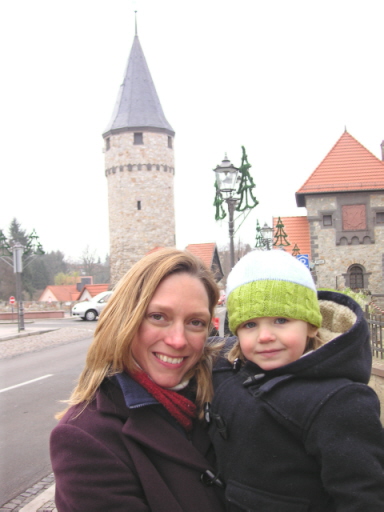
The next day we stopped by the Frankfurt Christmas market and visited our friend Millicent in her hair salon. She had no idea we’d be in Frankfurt, so she was extremely surprised when we walked through her door. Fortunately her customers were patient enough to wait for another hour or so while we visited. We finally tore ourselves away to jump on a train and head for Munich.

In Munich we visited Jason, Lili, and their two-year-old son, Constantin Paul-Friedrich. CPF’s second birthday was the day after we arrived, so we celebrated with him and four of his small friends, plus their parents. Jason & Lili’s usual hospitality was in full swing, (huge breakfasts in the morning, great German dinners at night) and we got to see Drei Haselnüsse für Aschenbrödel, a mid-1970s film version of Cinderella that’s the German equivalent of It’s a Wonderful Life.
We also took plenty of time to stroll through Munich’s Christkindlmärkte, including the new medieval Christmas market. (Just the place to find that crossbow you’ve always wanted.)


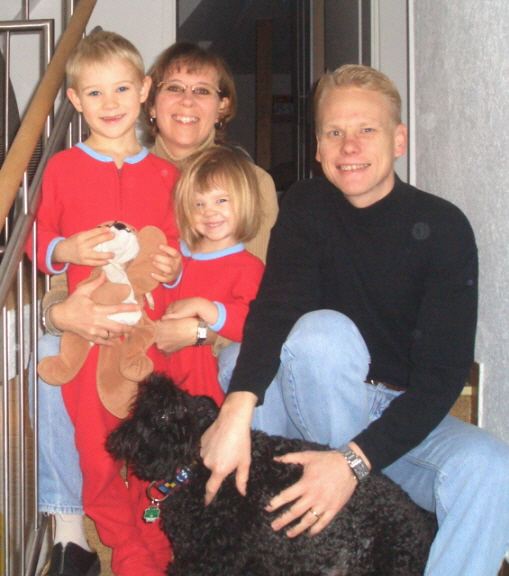
After three days in Munich, we went back in the direction of Frankfurt to Bad Homburg to stay with the Bealls – Ben, Mary, six-year-old Jack, three-year-old Sara, and Max (the black, fuzzy one).


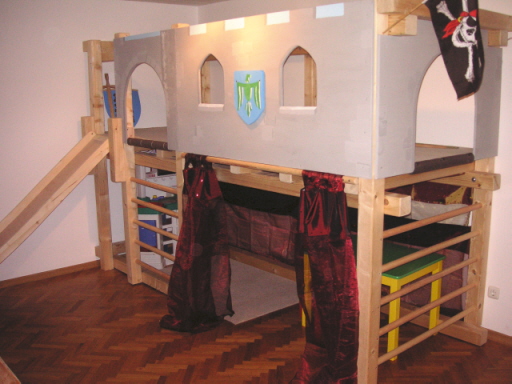
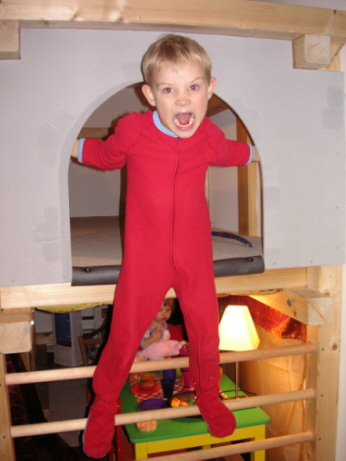
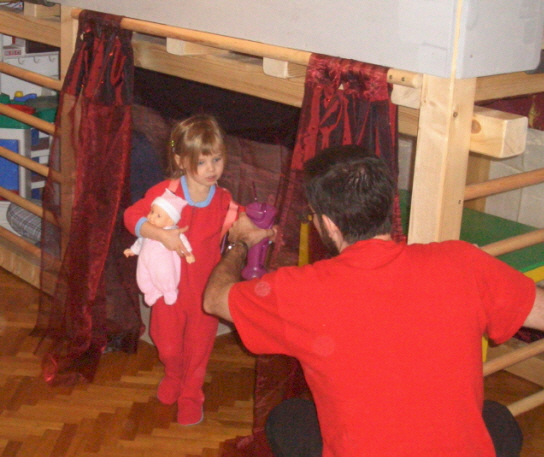
We had plenty of work to do on a special Christmas surprise: Fort Beall, constructed especially for the kids’ playroom. Santa did a great job constructing the fort, but it still needed sanding, painting, carpeting, and decorating. (Actually, the hardest part was making sure the kids didn’t see it until Christmas morning!) Work paused for us to go to Christ-the-King (our former church home) for a Sunday morning service, a wonderful lamb dinner with the Beall’s good friends Margareta and Nora, and the children’s Christmas pageant in the afternoon. We gave up around 1:30am, but Ben finally finished the fort around 2:00am on Christmas morning.


Christmas morning with Jack & Sara was great fun. We had a lovely, lazy day indoors, looking out the windows for snow (Ben’s sure he saw one flake), playing with the kids and cooking a fantastic pork tenderloin dinner. Our friend Claudia came over with seven-year-old Benedict in the afternoon – we all had a lovely day, and young ones & old ones slept well on Christmas night.


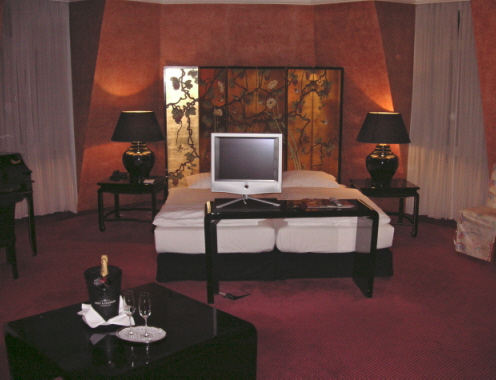
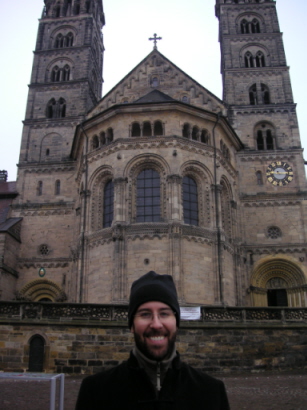
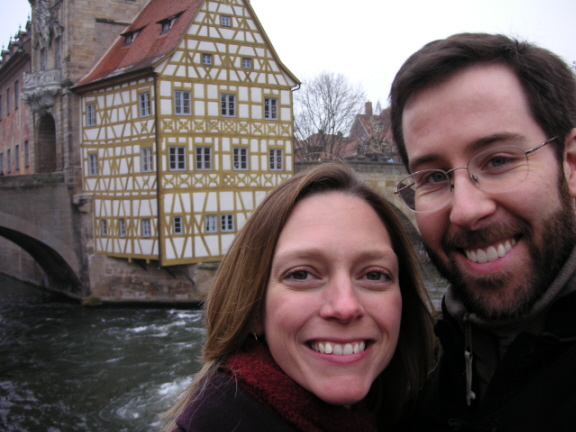
After another day in Bad Homburg, we decided we needed some private time for our third wedding anniversary. Jennifer had the inspiration that we should go someplace we’d never been before, so we took the train back into Bavaria to the more than 1000-year-old city of Bamberg. Bamberg was not bombed during the Second World War, so the old part of the city features literally hundreds of buildings that are up to 800 years old. We managed to find a fabulous place to stay at the Bamberger Hof Bellevue hotel, who set up a little anniversary package for us.


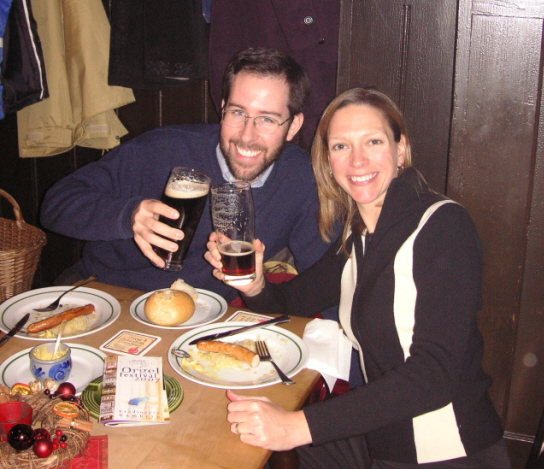
We spent many happy hours strolling around, visiting churches, eating great Wurst mit Sauerkraut, drinking the specialty Rauchbier (smoked beer) of Bamberg, and generally being romantic and stuff.


Bamberg calls itself the “Krippenstadt” (City of Nativity Scenes), so there were Nativities from all over the world to be seen in almost every shop window, as well as in churches and museums. While we were there, Bamberg had a special celebration to commemorate the 1000th anniversary of its bishophric. Kids dressed as the Three Wise Men came from all over Germany to sing and parade through the town.

We stopped by an art dealer to poke through some of their treasures when Jennifer found something extraordinary: an incredibly detailed, hand-colored, three-dimensional-map of Frankfurt from 1567. After talking with the dealer and taking a couple of hours to think about it, we decided it would be an ideal anniversary present. As we explained to the people in the shop, Frankfurt doesn’t really have the reputation of being a romantic city, but for us, it doesn’t get much better.


We also spent an evening at the Bamberg Marionette Theatre, where we saw a folk version of Doctor Faustus. This was no theater for little kids! The puppeteers use an original 19th-century marionette theater together with their own handmade puppets. After the show, we got to go backstage to see how it all worked. The puppeteers are immensely proud of their theater, which (among other tricks) features a five-story (scale) drop. As our hostess told us, “Only we and the Metropolitan Opera in New York can sink a whole ship on stage.” It was a weird and wonderful dose of culture to round out our trip.

The next day we headed back to Frankfurt for one last visit. We had dinner with Allan, the priest who married us, and his family. His nephew and a friend were visiting, so we had a lovely conversation to go along with the delicious meal Gretchen had prepared. We all agreed that it was a little strange to be there – even though we’d been gone for three years, it felt like we’d never left.

Alas, reality set in at 5:00am the next morning when we got up to go to the airport. We seem to have made flying on New Year’s Eve a tradition – this was the third time we’ve done it. Thanks to the efforts of a friendly German lady in Frankfurt and a friendly French lady in London, we were upgraded from “economy” to “economy plus,” and landed safely in Dhaka at 1:30am on New Year’s Day. Bhago was very happy to see us, and while we can’t say that we’re exactly happy to be back in Dhaka, we’re definitely rejuvenated and ready for more of our continuing adventure.

Creative Commons License
The Wilson Odyssey by http://wilsonodyssey.blogspot.com is licensed under a Creative Commons Attribution-NonCommercial-NoDerivs 3.0 United States License.